
Gates of Olympus 2500 RTP, Volatility and Max Win
Gates of Olympus 2500 RTP is 96.52%, and Pragmatic Play pairs that return with high volatility and a maximum win of 25,000x. Those three numbers describe the same machine from different angles. The RTP is the long-run average, the volatility is how unevenly that average is paid out, and the 25,000x ceiling is where the multiplier system stops. The multiplier symbols carry values from 2x up to 2500x, and the way they add together across a tumble sequence is what links the three figures.
Gates of Olympus 2500 RTP, volatility and the win ceiling
The top of that bet range belongs to the special bets: standard spins run from $0.20 to $240, the Ante Bets cost 1.25x, 2.75x or 5.5x the standard stake, and Super Spin 2 reaches $60,000 per spin. None of those modes changes the 25,000x ceiling or the multiplier values a symbol can take. If you want to put the numbers to work with real stakes, view the listed real-money options.
Game parameters
| Parameter | Value |
|---|---|
| RTP | 96.52% |
| Volatility | High |
| Maximum win | 25,000x |
| Multiplier symbol values | 2x to 2500x |
| Grid | 6×5, symbols pay anywhere |
| Bet range | $0.20 to $60,000.00 |
| Provider | Pragmatic Play |
| Release date | 2026-09-28 |
What the 96.52% theoretical return tells you
A 96.52% RTP is a property of the game's maths, calculated over an enormous number of spins. Across that long run, the game returns 96.52% of everything staked as wins, and the remaining share is the house edge built into the design.
It says nothing reliable about one session. A hundred spins, or a thousand, are far too few for the average to show itself, and on a game built around rare, very large multiplier hits, a short session can end well above or well below that figure. The RTP is the right number for comparing Gates of Olympus 2500 with other slots as a product. It is the wrong number for predicting what your next hour will look like.
Why high volatility matters
High volatility describes how the 96.52% is distributed. A high-volatility game concentrates a large part of its return in a smaller number of big results, so the path between them is uneven. In Gates of Olympus 2500 the source of that concentration is easy to see: multiplier symbols worth anywhere from 2x to 2500x land at random during spins and tumbles, and when several of them sit on the screen at the end of a winning sequence their values are added together.
The free-spins round pushes the same way. In every free-spins type the multiplier values build into a total multiplier rather than resetting with each sequence, and in the two Super modes no multiplier symbol is worth less than 10x. A volatility rating is a classification, not a measured hit rate, and Pragmatic Play's rating here tells you about the shape of the returns, not how often any particular result arrives.

A 2500x symbol is not the 25,000x maximum win
Three different numbers get confused here. The first is the value of a single multiplier symbol: one of 2x, 3x, 4x, 5x, 6x, 8x, 10x, 12x, 15x, 20x, 25x, 50x, 100x, 250x, 500x, 1000x, 1500x, 2000x or 2500x. The 2500x in the game's name is the top of that list, the largest value one symbol can show.
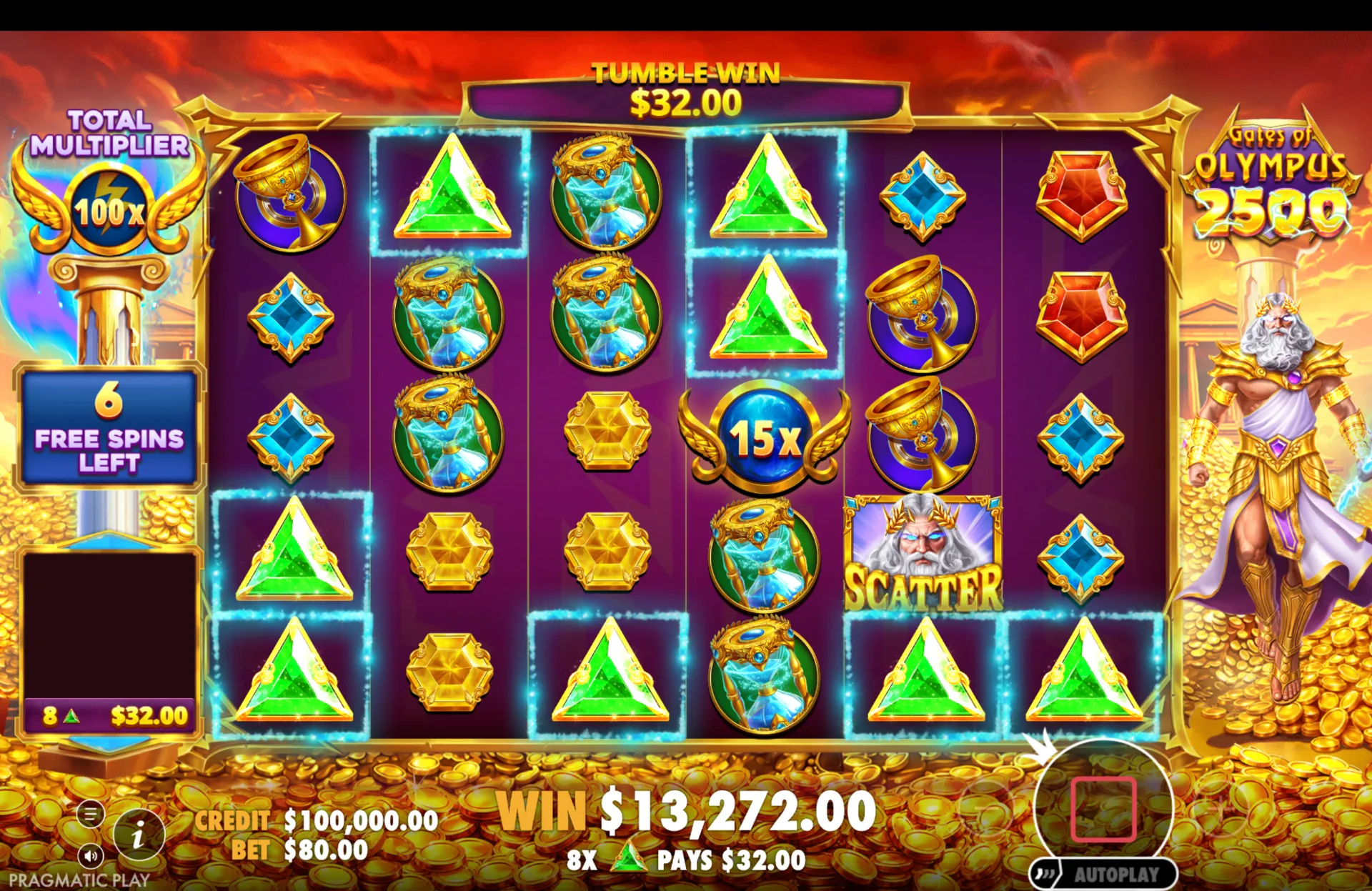
The second is the combined multiplier. Every multiplier symbol on screen when a tumble sequence ends is added to the others, and the sequence's total win is multiplied by that sum. In free spins the values feed a running total multiplier instead.
The third is the 25,000x maximum win, the overall ceiling on what the game pays. It is a cap, not a target the multipliers are steering towards, and it is not a statement of how likely any result is. The game publishes the ceiling; it does not publish odds of reaching it.
Following a win through the multiplier calculation
Illustrative calculation: one base-game spin (not a recorded result)
- The spin lands. Any eight or more matching symbols anywhere on the 6×5 grid form a win, paid by base bet.
- The winning symbols disappear, the remaining symbols fall, and new ones drop in from above. Each new win is added to the running total, with no limit on the number of tumbles.
- Multiplier symbols can land on the first spin or on any tumble. Suppose two land during the sequence, one with value A and one with value B.
- When no further wins appear, the sequence has paid a total of W. The multipliers are added: A + B.
- The sequence pays W × (A + B), and the whole amount reaches the balance only after every tumble from that spin has been played.
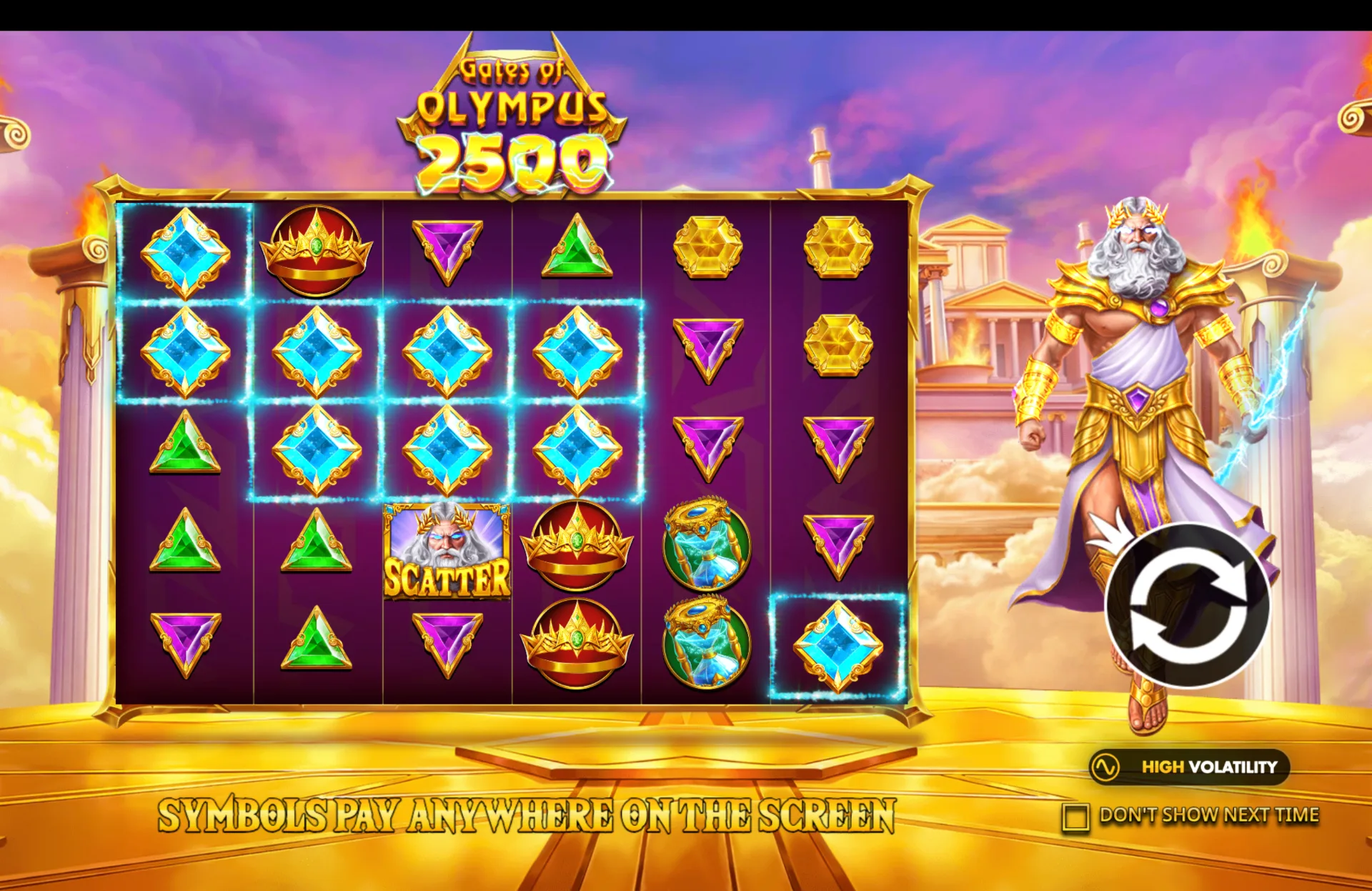
The size of W comes from the symbol pays, which range from 8–9 blue gems at the bottom to 12 or more crowns at the top; see the complete symbol payouts for every symbol and count. The base game resets after each sequence. Free spins do not: four or more scatters award 15 free spins, a wheel picks one of four modes, and in each mode the multipliers build a total multiplier that carries forward. The details of each mode, including how bonus multipliers accumulate, are where the high volatility really lives.
Free-spins modes and how the total multiplier is used
| Mode | Total multiplier applies to | Minimum multiplier symbol | Buy price |
|---|---|---|---|
| FREE SPINS 1 | Qualifying wins; only multipliers that hit and take part in a win are added | 2x | 100x total bet |
| FREE SPINS 2 | Wins throughout the round; every multiplier value is added | 2x | 250x total bet |
| SUPER FREE SPINS 1 | Qualifying wins; only multipliers that hit and take part in a win are added | 10x | 500x total bet |
| SUPER FREE SPINS 2 | Wins throughout the round; every multiplier value is added | 10x | 1,250x total bet |
The modes 2 pair is the more aggressive design in my view: every multiplier joins the total, and the total works on every win for the rest of the round. Three or more scatters during any mode add 5 more spins, giving the total more time to grow. Ante Bet 3, at 110x the bet multiplier, raises the natural free-spins chance eightfold and makes the three stronger modes more likely to be selected. The clearest way to see the calculation is to watch it run: follow the mechanics in the demo and count the multipliers left on screen when a sequence ends.